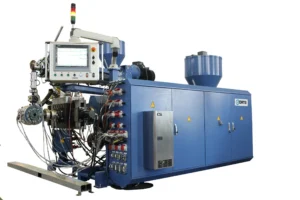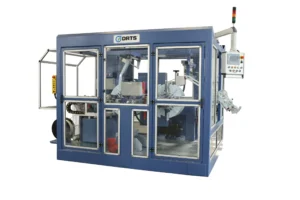
In pipe extrusion, manufacturers often focus on the extruder, die, and cooling tanks. While these are important, the pipe coiler plays a critical role in determining whether the finished product is easy to store, transport, and install.
A pipe coiler is not an optional extra. It is the final quality gate in your extrusion line. Get it wrong and everything upstream suffers. Get it right and your entire operation becomes smoother, faster and more profitable.
What a Pipe Coiler Actually Does
At its simplest, a pipe coiler takes finished pipe from the haul off and winds it into consistent, compact coils. These coils are then ready for storage, shipping or direct sale.
In reality, the job is far more technical.
A properly designed pipe coiler controls tension, speed and alignment as the pipe is wound. It ensures the pipe maintains its shape, wall thickness and surface quality while being coiled at production speed. Poor coiling creates ovality, kinks, stress marks and uneven coils that customers hate handling.
This is why pipe coilers are engineered specifically for extrusion lines rather than adapted from generic winding equipment.
Why the Coiler Matters More Than Most People Think
The coiler sits at the end of the line, but its impact runs all the way back to the extruder.
If the coiler cannot keep up with line speed, you are forced to slow production. That immediately increases the cost per foot.
If tension is inconsistent, you risk deforming the pipe. That creates rejects, customer complaints and wasted material.
If coils are loose or uneven, packaging becomes inefficient, and transport costs rise. Installers notice this instantly. They remember which suppliers make their lives easier.
In short, a weak coiling solution limits throughput, damages product quality and quietly erodes margins.
Manual, Semi-Automatic and Automatic Coilers
Not all pipe coilers are the same, and choosing the wrong type is a common mistake.
Manual coilers rely heavily on operators. They are cheaper upfront but introduce variability and slowdowns. They rarely make sense for growing manufacturers.
Semi-automatic coilers strike a balance. They automate much of the winding process while keeping operator involvement manageable. These are often ideal for medium output lines or pipe diameters over 2 inches.
Fully automatic coilers are built for consistency and speed. They synchronize perfectly with the extrusion line, adjust automatically to pipe dimensions, and deliver uniform coils shift after shift. For high-volume production, this is where real efficiency gains appear.
Integration Is Everything
A pipe coiler can be added to an existing extrusion line, but care should be taken to ensure that it communicates and is synchronized to the entire line. It must integrate seamlessly with the rest of the extrusion line.
This means matching line speed, pipe diameter range, material behavior and coil size requirements. It also means reliable communication with the haul off and cutter so the entire line runs as one system.
This is where experience matters. At DRTS, coilers are not specified in isolation. They are selected and configured as part of the complete production process to avoid bottlenecks and future limitations.
Why Manufacturers Choose DRTS Coilers
DRTS works with manufacturers who want reliability, not compromises.
Our pipe coilers are designed for real-world production environments where uptime, consistency and ease of operation matter. Whether you are running PVC, PE, PPR or irrigation pipe, the focus is always on stable coiling, clean handling and repeatable results.
Just as importantly, DRTS provides technical guidance before and after installation. That means helping you choose the right coiler, integrating it correctly into your line and supporting your team once production starts.
You can view our full range of pipe coilers here
A pipe coiler is not just a finishing machine. It is a productivity tool, a quality control mechanism and a cost reduction lever rolled into one.
If your coils look bad, your customers notice. If your coiler limits speed, your margins suffer. If your coiler is properly matched to your extrusion line, everything downstream becomes easier.
That is why choosing the right pipe coiler and the right supplier matters more than many manufacturers realize.
Frequently Asked Questions
What types of pipe can be coiled?
Pipe coilers are commonly used for PE, HDPE, LDPE, PVC, PPR, PEX and irrigation pipes. The key is matching the coiler design to pipe flexibility, diameter and finished coil dimensions.
Can a single coiler handle multiple pipe sizes?
Yes, many modern coilers are designed with adjustable ranges. The usable range depends on pipe diameter, wall thickness and material.
What production speeds can pipe coilers handle?
This depends on whether the coiler is manual, semi-automatic or fully automatic. High-end automatic coilers are built to run continuously at full extrusion speed.
Is a coiler required for all extrusion lines?
Any line producing a flexible pipe intended for coiling will require a coiler. Rigid pipelines typically use cutting and stacking systems instead.
How do I choose the right pipe coiler?
You should consider the material type, the pipe diameter range, finished coil dimensions, the available floor space, and the desired automation level. A supplier who understands full extrusion lines can guide this process properly.