
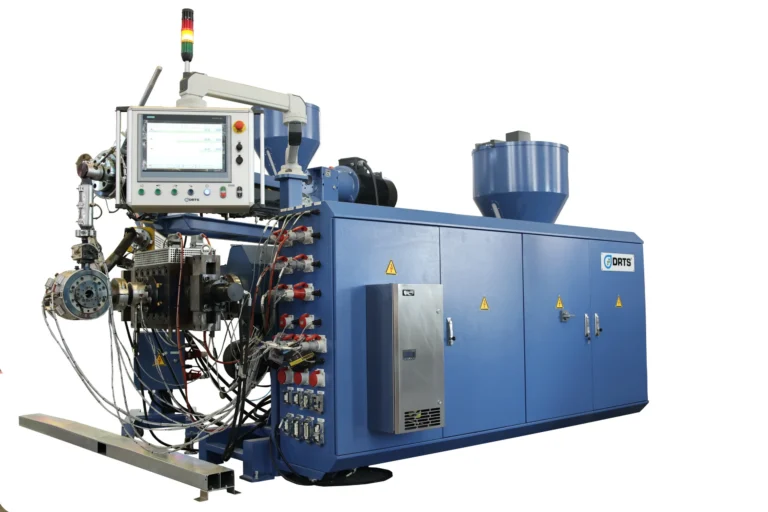
If you work in pipe manufacturing, plastics processing, or industrial production, the word “extruder” gets used constantly. But for anyone stepping into this world for the first time, or looking to understand what actually sits at the heart of a production line, the question is a fair one. What exactly is an extruder, and what is it doing while your line is running?
Let’s get into it.
An extruder is a machine that takes raw plastic material, melts it down, and pushes it through a shaped opening called a die to produce a continuous profile. That profile can be a pipe, a tube, a sheet, a hose or any number of other forms depending on the die design and the material being processed.
It sounds straightforward, and at its core it is. But the engineering that goes into making that process consistent, efficient and scalable is where things get interesting.
How an Extruder Actually Works
Picture a large metal barrel, heated along its length, with a rotating screw running through the middle of it. Raw plastic pellets or granules are fed into one end of that barrel through a hopper. As the screw rotates, it moves the material forward through zones of increasing heat and pressure.
By the time the material reaches the end of the barrel, it has gone from solid granules to a fully molten, homogeneous plastic melt. That melt is then forced through the die at the front of the machine, taking on the shape of the die opening as it exits. For pipe production, the die is designed to produce a hollow cylindrical profile at precise dimensions.
Once the pipe exits the die, it moves through a calibration and cooling system that sets the shape and hardens the material. From there, a puller machine draws the pipe along the line at a controlled speed, and a cutter or coiler handles the finished product at the end.
The extruder itself is the engine driving the entire process. Everything else on the line depends on it running consistently.
Single Screw vs Twin Screw
There are two main extruder configurations you will encounter in pipe manufacturing. Single screw extruders are the most common and are well suited to processing PE, PPR and most standard pipe applications. They are reliable, efficient and straightforward to maintain.
Twin screw extruders use two intermeshing screws rotating within the same barrel. This configuration provides superior mixing and is particularly effective when processing PVC, where the compound needs to be broken down and blended more intensively before it is ready to form a pipe.
At DRTS, both single screw and twin screw extruders are part of the range, each designed around the specific demands of the material and the production outcome the customer needs.
Why Screw and Barrel Design Matters
The screw is not just a conveyor. Its geometry, specifically its length to diameter ratio, the depth of its flights, and the transition between processing zones, determines how well the plastic is plasticised before it reaches the die.
A poorly designed screw leaves inconsistencies in the melt. That means variation in pipe wall thickness, surface defects and pressure fluctuations that ripple through the entire line. Get the screw design right for your material combination and you get a homogeneous melt, stable output and pipe that meets specification consistently.
The barrel works in tandem with the screw. Temperature control across the barrel zones is precise and deliberate. Each zone serves a purpose, whether that is softening the incoming material, building pressure, or homogenising the melt before it exits.
What Materials Can an Extruder Process?
In pipe production, the most common materials are PE (polyethylene), PVC (polyvinyl chloride) and PPR (polypropylene random copolymer). Each behaves differently during processing, has its own melting characteristics and places different demands on the extruder.
PE is widely used across water supply, gas distribution and drip irrigation applications. PVC is common in pressure pipe, drainage and construction. PPR has strong application in hot and cold water plumbing systems. A well-engineered extruder, with a screw designed for the intended material, will handle each of these efficiently and without compromise.
From Single Machine to Turnkey Line
An extruder does not operate in isolation. In a functioning pipe production line, it sits at the front of a sequence of equipment that includes the die head, vacuum sizing tank, cooling tanks, pullers, cutters and, depending on pipe diameter, a coiler for finished product handling.
DRTS builds both individual extruder machines and complete turnkey production lines, giving manufacturers the option to integrate a new extruder into an existing setup or commission an entire line from scratch. Every machine in the line is designed to communicate and operate as a system, not a collection of standalone units bolted together.
Frequently Asked Questions
What is the main purpose of an extruder in pipe manufacturing? An extruder melts raw plastic material and forces it through a die to produce a continuous pipe profile. It is the primary processing machine in any pipe extrusion line and determines the quality and consistency of everything produced downstream.
What is the difference between a single screw and a twin screw extruder? A single screw extruder uses one rotating screw to melt and convey material and is suited to PE and PPR pipe production. A twin screw extruder uses two intermeshing screws and provides more intensive mixing, making it the standard choice for PVC processing.
How does the screw design affect pipe quality? The screw geometry controls how material is melted, mixed and pressurised before it reaches the die. The right screw design for a given material produces a consistent, homogeneous melt and stable output. The wrong one introduces variation that affects wall thickness, surface finish and structural integrity.
Can one extruder process different plastic materials? It depends on the machine specification. Some extruders are designed for flexibility across materials. Others are optimised for a specific material and application. Screw design, barrel configuration and temperature ranges all factor into material compatibility.
What does a turnkey pipe extrusion line include? A turnkey line covers the full production process from raw material feed to finished pipe. This typically includes the extruder, die head, calibration and cooling systems, pullers, cutters and coilers, all configured to work as an integrated system.How do I know which extruder is right for my production needs? The answer depends on the material you are processing, the pipe diameters and wall thicknesses you need, your target output rate and the infrastructure you are working with. DRTS works directly with manufacturers to specify the right machine and line configuration for the application, including customisation where standard configurations do not fit.